Jacques Brel was born in Brussels in 1929 into a modest Belgian family. From an early age, he showed a strong sensitivity to words, music, and storytelling. In the early 1950s, driven by an uncompromising passion for creation, he left Belgium for Paris, determined to make his voice heard. The beginnings were difficult, marked by doubt and anonymity, but Brel’s intensity, sincerity, and refusal to compromise gradually set him apart.
By the end of the 1950s, Jacques Brel had become one of the most powerful figures in French language music. His songs were not simply melodies, but emotional narratives that spoke of love, solitude, social hypocrisy, friendship, and human fragility. On stage, he gave everything. His performances were physical, raw, and deeply moving. By 1960, he was at the height of his artistic rise, already recognized as a major poet and performer whose work would leave a lasting mark on generations.
Despite growing fame, Brel remained uncomfortable with celebrity. He sought silence, authenticity, and moments away from the public gaze. Travel, encounters, and distant places offered him breathing space and inspiration beyond concert halls and recording studios.
Hammamet, an Artistic Refuge by the Sea
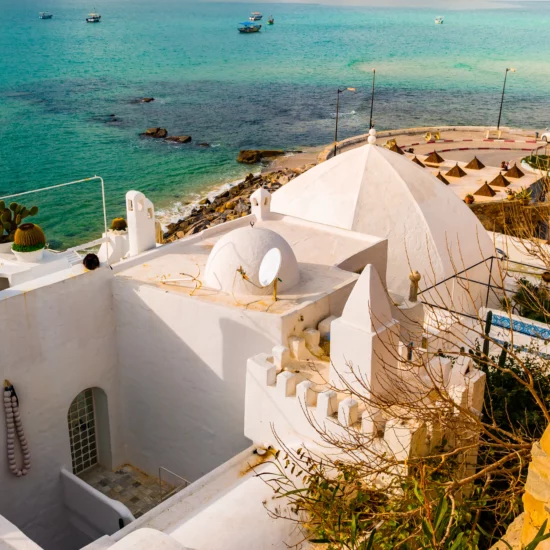
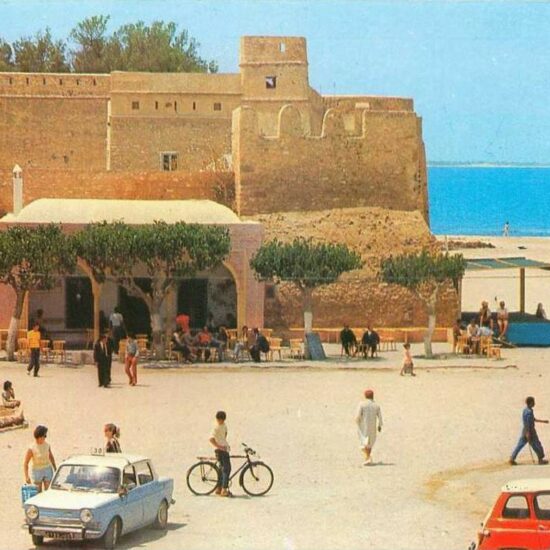
Since the beginning of the twentieth century, Hammamet had attracted artists, intellectuals, and free spirits from Europe and beyond. This small Tunisian coastal town, still untouched by mass tourism, offered something rare: light, calm, hospitality, and a simple relationship to life. Hammamet was not a place of spectacle, but a place of presence.
As early as the 1910s and 1920s, the painter Paul Klee stayed in Hammamet, where the Tunisian light profoundly influenced his artistic vision and approach to color. A few years later, Georges Sébastien, a Franco Romanian patron of the arts, fell in love with the town and founded the Club Sébastien, which quickly became a cultural meeting point for writers, musicians, actors, and thinkers from around the world.
Over the decades, Hammamet continued to attract artists seeking discretion rather than fame. Singers, filmmakers, and actors passed through quietly, drawn by the town’s Mediterranean and Eastern atmosphere and its deeply human rhythm. Figures such as Georges Moustaki, seen in Hammamet, naturally became part of this tradition of understated but meaningful visits.
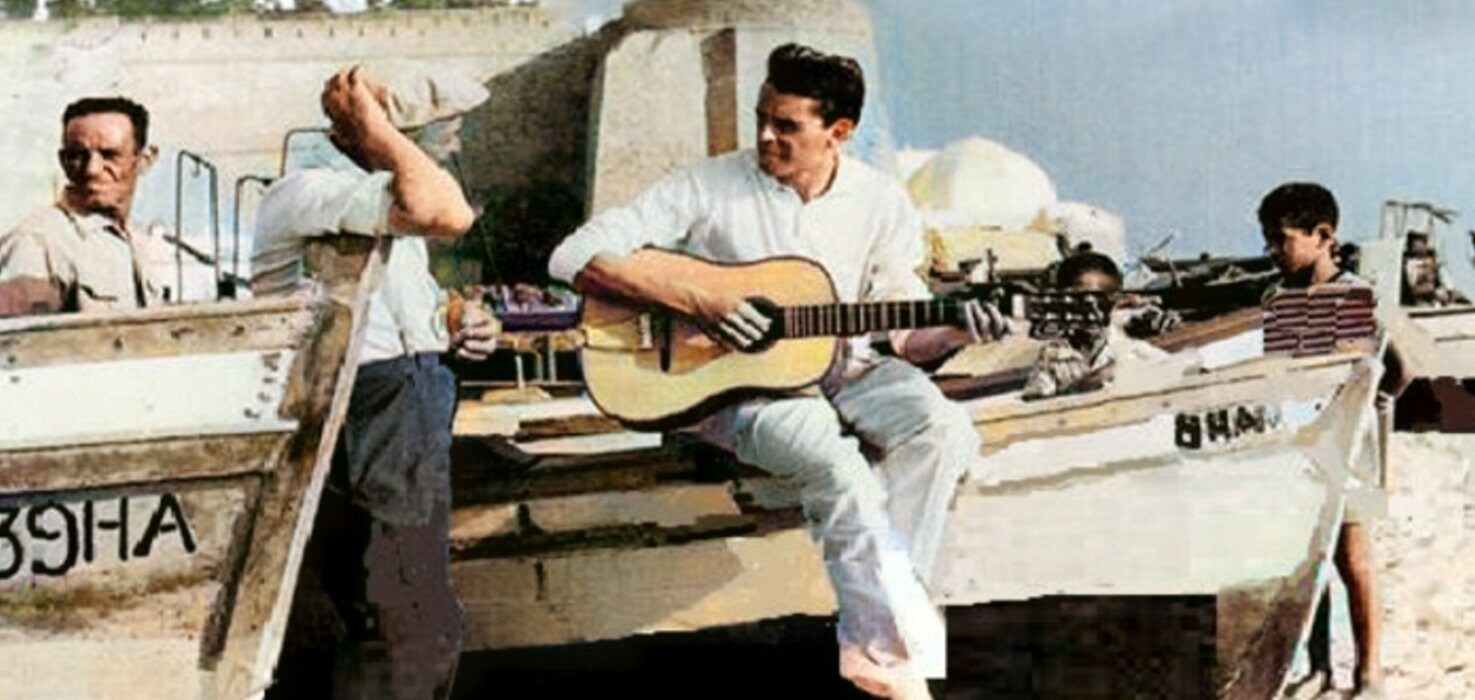
Jacques Brel in Hammamet in 1960
It was within this cultural and human landscape that Jacques Brel came to Hammamet in 1960. His visit was not a public event, but a personal moment, a pause in a life increasingly shaped by success and pressure. Hammamet offered him what he valued most: simplicity, direct human contact, and a sense of freedom far from the expectations of the stage.
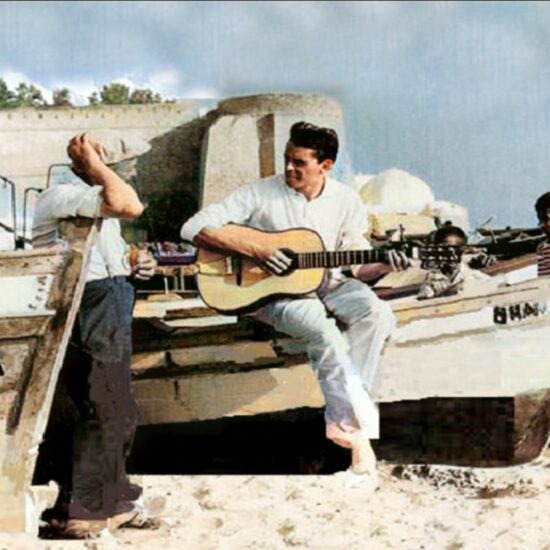
The photograph often associated with this visit shows Jacques Brel on the beach or aboard a small boat, guitar in hand, surrounded by Tunisians. The image is striking not because of celebrity, but because of its intimacy. It shows neither performance nor distance, but sharing. Brel appears relaxed, attentive, almost anonymous. Hammamet is not an exotic backdrop in this moment. It is a space of breathing, conversation, and quiet presence, a place where the artist could briefly return to himself.
Hammamet, a Discreet Crossroads of Creative Souls
Hammamet’s attraction for artists has never been based on glamour. Its strength lies in authenticity, a beauty without excess, a gentle pace of life, and a natural relationship between inhabitants and visitors. For artists like Jacques Brel, this simplicity was essential. It allowed inspiration to flow without constraint.
Brel’s presence in Hammamet in 1960 belongs to a broader history, that of a town which, through its light, rhythm, and humanity, contributed quietly to global cultural life. Long before tourism campaigns and brochures, Hammamet built its international reputation through encounters, silences, and shared moments.
Even today, these memories remind us that Hammamet is not only a seaside destination. It is a place of passage for free spirits, a town where creation, rest, and human connection meet naturally, just as they did when Jacques Brel walked its shores in 1960.
Extremely motivated to constantly develop my skills and grow professionally. I try to build my knowledge, flexibility, and interpersonal skills through several projects and within different teams.







No Comment! Be the first one.